A Note From Your Watershed Coordinator

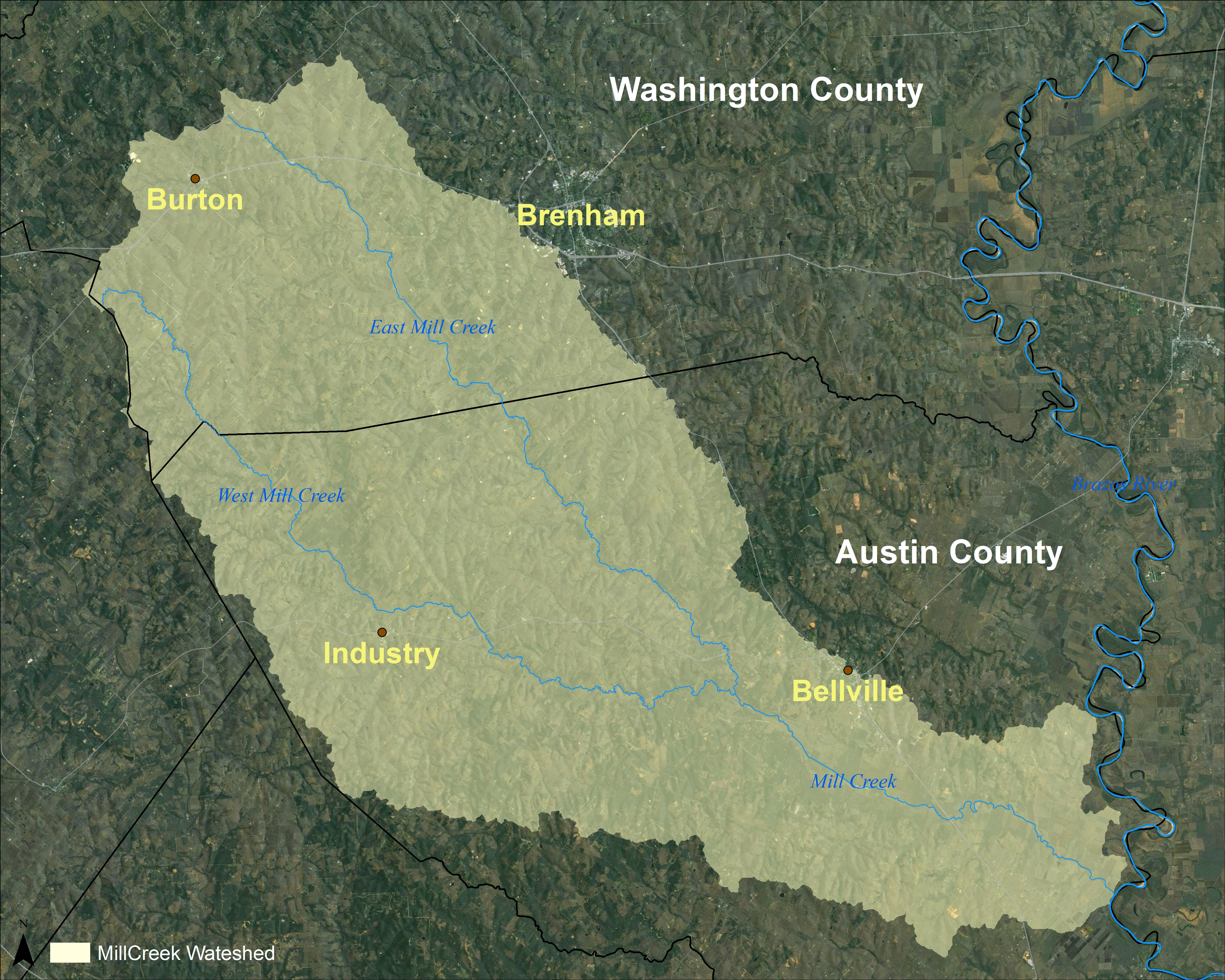
Do you know of a local bridge crossing over Mill Creek that needs a facelift? This winter and spring, we are coordinating a creek cleanup event that might be able to help! In previous years, we hosted a dumpster at a central location and asked people in the watershed to bring trash from the watershed to us. This year, we’re going out into the watershed to pick up litter ourselves! But we need your help. If you know of a spot that has collected litter or tires that need to be removed, email your watershed coordinator today. Then, when you see the announcement for the Fall Cleanup, sign up to volunteer with us!
As we plan and prepare for educational and outreach events, we are looking for your input! Is there a topic you want to learn more about, or maybe an issue in Mill Creek that you would like to see addressed? Please reach out and let us know so we can best serve the stakeholders of the Mill Creek Watershed Partnership.
Annalee Epps
Annalee.epps@ag.tamu.edu
Measurements Matter: E. coli Bacteria
Did you know that Mill Creek has an elevated level of E. coli bacteria? This impairment was identified by the Texas Commission for Environmental Quality in 2014, based on 7 years of water quality data collected in Mill Creek. But what do elevated levels of E. coli bacteria mean for water quality? This article continues our series exploring water quality data collected in our watershed and why it matters.
E. coli bacteria are a large group of organisms that can be found in the digestive systems and waste products of warm-blooded animals, including humans. They are also naturally occurring in creeks and streams! The level of E. coli in a water sample is measured in colony forming units per 100 mL (cfu/100mL). To measure cfu, a water sample is collected and taken to a laboratory. There, samples are diluted and incubated on petri dishes. Bacterial colonies are then counted, allowing the estimation of viable bacteria in the original sample.

These bacteria are used as an indicator organism. When levels of E. coli bacteria are elevated, that indicates that the water has come into contact with waste from warm-blooded animals. Other dangerous pathogens could be present in this case, posing a health risk for anyone who is exposed to them. We measure E. coli bacteria because it is a relatively quick and inexpensive process compared to testing for other pathogens.

Changes in E. coli bacteria levels can be associated with variation in temperature, streamflow, and dissolved oxygen. However, increased E. coli bacteria can also be the result of nonpoint source pollution. Waste from feral hogs, pets, livestock, or even humans can be washed into the creek. Reducing sources of pollution is the goal of the Mill Creek Watershed Partnership, so tracking the level of E. coli bacteria in the creek is crucial to identifying pollution sources and measuring project effectiveness. We measure E. coli bacteria because it matters!
Watershed Calendar
Mill Creek Cleanup Event – Winter 2026
This year, we are mixing things up for the Mill Creek Cleanup Event – be on the lookout for more information about how you can be involved!
————————————————————————————————
Funding for this effort is provided through a Clean Water Act §319(h) Nonpoint Source Grant administered by the Texas State Soil and Water Conservation Board from the U.S. Environmental Protection Agency.
Texas A&M AgriLife Extension Service is an equal opportunity employer and program provider.